
Lucy Profiles
Lucy is a dedicated expert answer engine designed to help teams find the right person to answer specific questions. In Lucy 4, collaborative and user-centered features were emphasized — but at the time, there was no centralized profile page.
Role: UX Designer
Team: Product Manager, Engineers, Customer Success
Timeline: 6 Months
My Contribution: I led the research, design, prototyping, and implementation for the Profile Page experience, transforming fragmented user settings into a unified and expandable identity page for users
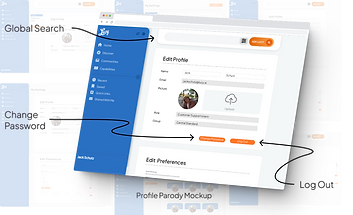
A screenshot of the profile functionality.
The Challenge
Users couldn’t easily find or update their profile, and there was no structural foundation for future People Search features — leading to fractured UX and limited expandability.
Opportunity
-
Create a centralized, scalable Profile feature that:
-
Supports identity, preferences, and future search capabilities
-
Aligns with broader strategic goals for People Search
-
Enhances usability and consistency of the platform
Existing Experience
I started by exploring Lucy 3’s current UI to understand how users managed profile preferences. I found:
-
Profile information lived in separate locations
-
Users lacked clarity on where personal data lived
-
There was redundancy and cognitive friction
This discovery motivated a consolidated approach.
_Page_07.png)
The existing Lucy v.3 interface features disconnected profile elements.
Goal Creation
After meeting with the product management team, we created a Goal Matrix — a prioritization tool that aligned team expectations and clarified what success looks like.
_Page_16.png)
A goal matrix was prioritized from objectives given to me by my PM.
Success was measured by:
-
Completion of prioritized user flows
-
Internal alignment with product strategy
-
Readiness for People Search expansion
Competitive &
Contextual Research
I researched common patterns for Profile pages across modern applications to understand:
-
What profile data users are willing to share
-
How successful products structure identity
-
How options and preferences are balanced without overwhelming users
I also facilitated a 90-minute design discussion with the Customer Success team to gain insights on how Lucy could evolve with deeper community features and how users might interact with profile information in the future.
This workshop helped shape strategic decisions and informed what data points should be surfaced and tested next.
_Page_31.png)
A design discussion led to quick ideation from team members.
Ideation & Concept Development
I explored multiple directions for the Profile UI, including:
-
Modular layouts vs static blocks
-
Scrollable sections for progressively revealing information
-
Ways to support future features like People Search and community connections
Explored navigation systems to balance discoverability and scalability.


After divergence, I chose a scrollable modular UI that:
-
Supports flexible content blocks
-
Scales with future feature expansions
-
Keeps the experience simple and familiar
I evaluated modular layouts, static panels, and hybrid scrolling — the scrollable modular pattern balanced flexibility and clarity best.
Final Design
With design direction defined, I created final mockups and handoff documentation. I worked closely with engineers, logging and tracking tickets in Jira to ensure:
-
Accurate implementation of UX intent
-
Data-driven profile content surfaced correctly
-
Interactions matched specification
Key outcomes:
-
Unified user profile page
-
Clear sections for personal info, preferences, and future extensibility
-
A foundation for People Search integration and personalization

The final profile mockup.
What I Learned
Even without formal usability testing data, this project reinforced several core learnings:
-
Early alignment with PMs saves iteration time: Co-creating goals ensured we were solving the right problem before designing.
-
Profile features are strategic infrastructure: Even simple features drive big future capabilities.
-
Workshops add strategic depth: Getting insights from customer success helped steer the design beyond UI and into real user value.
These lessons have already reshaped how I approach strategic UX initiatives, especially when multiple teams lean on a foundational feature.
If this feature continues evolving, I would prioritize:
-
User validation studies to understand pain points and preferences with real users
-
A/B testing for People Search impact
-
Personalization and recommendation system expansion
Each of these would tie back to strategic goals and have measurable impact.
.png)
The proposed future of people search.